
Before I go further, I must let you know that this is one of the longer sections of the site, so take your time. I hope you enjoy it and learn a lot about our next real home.
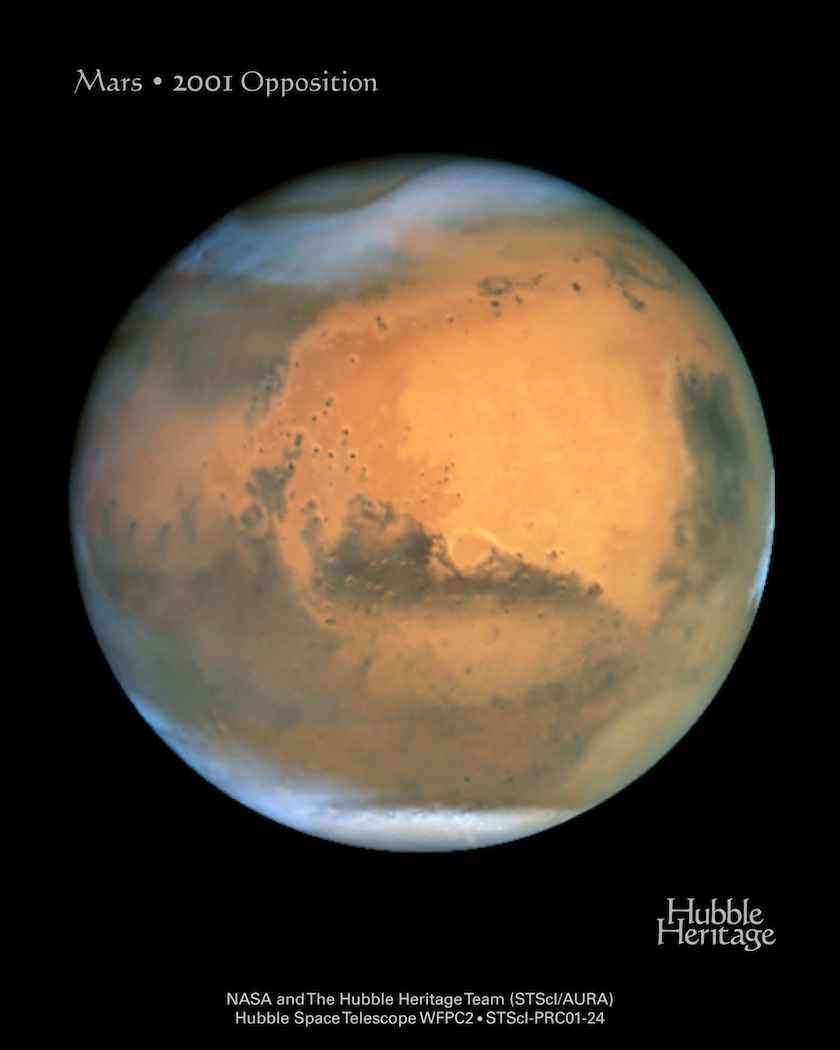
Mars is the fourth planet from our Sun, and is the last of our Solar System's terrestrial planets. After Mars, the planets are different, and we'll get to them, you'll see. It orbits the sun at about 1.66 AU which means that it is about 150 million miles from the sun and about 60 million miles from us - when we are lined up closely. Obviously, when both planets are traveling around our sun at different speeds, there are times where Mars is much further away from us, but it never gets closer that the 60m miles.
All the stuff about Mars being close and as big as the moon in our sky, represents a deep human longing, but is unfortunately, bunk.
A day on Mars is 39.5 minutes longer than a day on Earth, and a martian year is about 668 earth days, so about 20 Earth months. The fact that the day is a bit longer makes keeping track of time there really difficult as we would need new watches. Remember a day is the amount of time that it takes for the planet to rotate around itself, and a year is how long it takes to rotate around the sun.
So why do we have interest in Mars?
My opinion, as a specie, it is in our blood to explore. We have already determined that while we can look at Venus, it would be presently impossible to send humans there (except to orbit in the upper atmosphere). The atmospheric pressures on Venus are far too great and a human exploration team would be crushed on landing, if not before.
Planetary astronomer Carl Sagan (I’ll come back to him) wrote:
“Mars has become a kind of mythic arena onto which we have projected our Earthly hopes and fears".
But Mars is different. It is a long way away and incredibly cold, but we have long-standing outposts on Antarctica, and we know how to build shelters to protect us. So it is possible for us to go there.
Why would we want to?
Well, we have recently discovered -- through the Phoenix mission
 -- some water ice on Mars at the polar caps, and what we think are huge glaciers of water, just below the surface in a number of places. Some of the glaciers are three times bigger than the Los Angeles basin, which is huge.
Mars is much smaller than Earth, about half the size. It seems like it was formed about the same time as Earth, and in it's early days, had tectonic plates - the same as on Earth (when these plates move on Earth, we have Earthquakes). However, early in it's life, the tectonic plates melted together, and so now Mars is one plate. This means that there are no Mars Quakes, like we have Earth quakes, and in fact, there seems to be very little activity on Mars at all, except for freezing and unfreezing of ice (water and Carbon Dioxide) at the martian poles, in winter and spring.
There are also wild dust storms that can cover the whole planet at once!!
Despite all the problems, we could terraform Mars. Think about that. A second home for humanity.
BACKGROUND
We started to study Mars as son as we could see through telescopes, and we made huge errors in thinking about what was happening there.



In a 1901 interview Tesla said:
"It was some time afterward when the thought flashed upon my mind that the disturbances I had observed might be due to an intelligent control. Although I could not decipher their meaning, it was impossible for me to think of them as having been entirely accidental. The feeling is constantly growing on me that I had been the first to hear the greeting of one planet to another”.


"Early in December 1900, we received from Lowell Observatory in Arizona a telegram that a shaft of light had been seen to project from Mars (the Lowell observatory makes a specialty of Mars) lasting seventy minutes. I wired these facts to Europe and sent out copies through this country. The observer there is a careful, reliable man and there is no reason to doubt that the light existed. It was given as from a well-known geographical point on Mars. That was all. Now the story has gone the world over. In Europe it is stated that I have been in communication with Mars, and all sorts of exaggerations have spring up. Whatever the light was, we have no means of knowing. Whether it had intelligence or not, no one can say. It is absolutely inexplicable."
Pickering later proposed creating a set of mirrors in Texas with the intention of signaling Martians.

 .
.
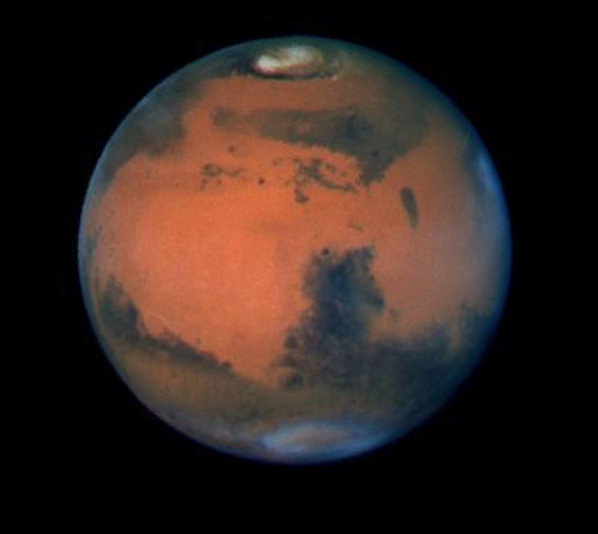
Now, fast forward to today. There may be water on Mars, but there are no martians that pose us any threats. Here is what the planet looks like.Click on it to see it full size:
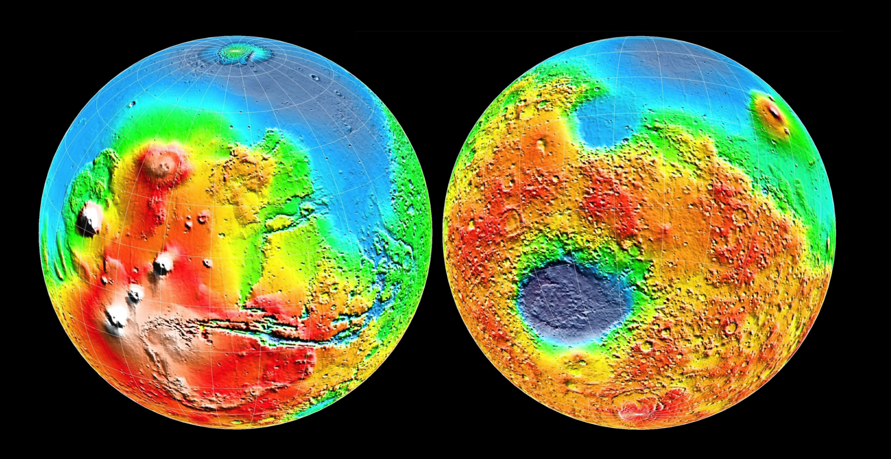
The image below was taken by the Mars Global Surveyor that has taken a fairly complete mapping of the planet. Click on it to see it full size (please give it time to load -- it’s a big image:
(For a full listing of spacecraft sent to Mars, go to the Robotic Exploration section of the site. However, I’d like to complete the Mars story here.)
We first landed a “geological” pair of spacecraft on Mars in the low lying area in 1976. They were the Viking landers. And they dispelled hope of finding any life on Mars. The soil samples looked just like sand or equivalent (iron oxide). The spacecraft had landed in what looked like dead areas. The scientific world was devastated. Mars was left alone for 20 years.
It was only when the Hubble Space Telescope and an early orbiter, the Mars Global Surveyor, saw ice at the North and South poles on Mars, and took some high-resolution pictures, like the one above, did we get interested again.
What really got scientists excited was the following image that we received from one of the new orbiters (MRO) that were sent there to have a second look. (Currently there are three orbiters there: The European Mars Express, and, Mars Odyssey and the Mars Reconnaissance Orbiter. Check out their respective websites).
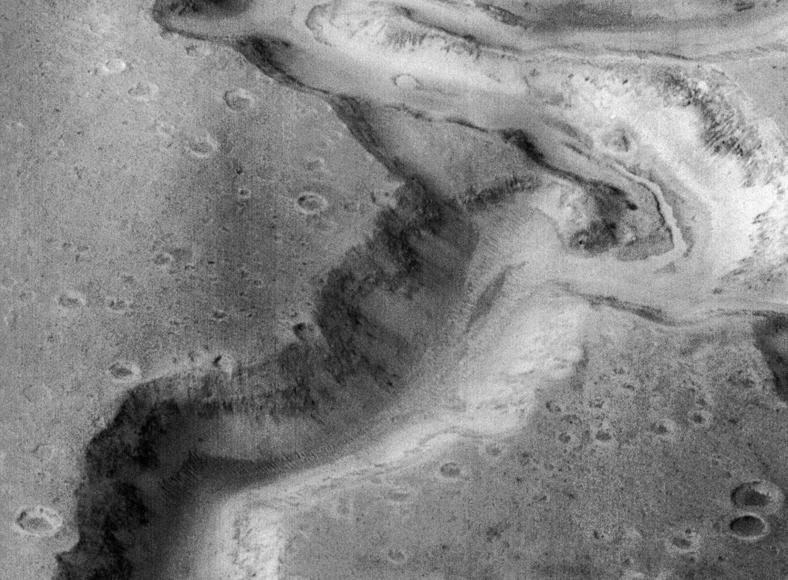
This is a river valley. Click on the picture to see a big image (again, please be patient). Notice towards the north of the valley, that there is a channel. Close inspection showed that the valley could only have been formed by a long period of water or glaciers, carving the rocky bed.
In 1998, we sent the Pathfinder probe to the planet, to test our ability to remotely control a “roving” spacecraft. That rover was the size of a Microwave oven -- it travelled about 30 feet, and bumped into a rock. But the concept worked. So we set about building real geological rovers that could spend 3 months exploring more interesting areas of the planet that we could determine from our new high-resolution imagery.
I will tell you about the next generation Rovers in the Exploration section of the site.
But the current discoveries and thinking about the planet has radically changed our thinking about the planet.

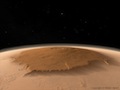
1. There is an abundant amount of water still on Mars, somewhat below the surface. Phoenix found some only inches below the surface. They may be underground glaciers that are as big as some of Earth’s seas.
2. There are caves to explore. We have found several large caves that are at least 200m wide and as deep as we can see.
3. Olympus Mons in the planet highlands, is the highest mountain in the solar system, at 27km. It is over three times the height of Mount Everest which in comparison stands at only 8.848 km.
4. Research in 2008 has presented evidence regarding a theory proposed in 1980 postulating that, four billion years ago, the northern hemisphere of Mars was struck by an object one-tenth to two-thirds the size of the Moon. If validated, this would make Mars' northern hemisphere the site of an impact crater 10 600 km long by 8 500 km wide, or roughly the area of Europe, Asia, and Australia combined and would be the largest impact crater in the Solar System.
5. The surface of Mars as seen from Earth is divided into two kinds of areas, with differing albedo. The paler plains covered with dust and sand rich in reddish iron oxides were once thought of as Martian 'continents' and given names like Arabia Terra (land of Arabia) or Amazonis Planitia. The dark features were thought to be seas, hence their names Mare Erythraeum, Mare Sirenum and Aurorae Sinus. The largest dark feature seen from Earth is Syrtis Major.
6. We have recently discovered seasonal
 methane at three points on Mars. One of these sites could be a good landing site for the next Mars Mission -- The Mars Science Laboratory.