Its launch and subsequent mission were both completed successfully. It was inhabited by two Soyuz crews.
The Soyuz 21 cosmonauts worked in the station from July 7 - August 24, 1976. Soyuz 23 was to have docked but its long-distance rendezvous system failed. The Soyuz 24 crew worked in the station from February 8 - 25, 1977. Its research module was ejected on February 26, 1977, and recovered. Soyuz 25 was planned, but the mission would have been incomplete due to low orientation fuel on Salyut 5, so it was cancelled. Salyut 5's orbit decayed, and it re-entered the atmosphere on August 8, 1977, after fuel reserves were depleted and the planned Soyuz 25 mission was no longer possible.
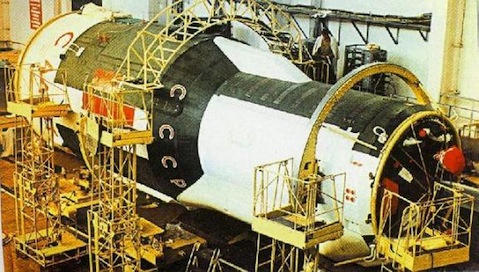
During the flight of Salyut 5 a 'parallel crew' was aboard a duplicate station on the ground. They conducted the same operations in support of over 300 astrophysical, geophysical, technological, and medical/biological experiments. Astrophysics studies included an infrared telescope-spectrometer in the 2-15 micrometer range which also obtained solar spectra. Earth resources studies were conducted as well as Kristall, Potok, Diffuziya, Sfera, and Reatsiya technology experiments. Presumably Salyut 5 was equipped with a SAR side-looking radar for reconnaissance of land and sea targets even through cloud cover.
The film capsule was ejected 22 February 1977 (and sold at Sotheby's, New York, on December 11, 1993!). In addition to the human crews, two Russian tortoises (Testudo horsfieldi) and Zebrafish (Danio rerio) were flown.
The results of the Salyut 3 and 5 flights showed that manned reconnaissance was not worth the expense. There was minimal time to operate the equipment after the crew took the necessary time for maintenance of station housekeeping and environmental control systems. The experiments themselves showed good results and especially the value of reconnaissance of the same location in many different spectral bands and parts of the electromagnetic spectrum.
Specifications
Length - 14.55 m
Maximum diameter - 4.15 m
Habitable volume - 100 m³
Weight at launch - 19,000 kg
Launch vehicle - Proton (three-stage)
Orbital inclination - 51.6°
Number of solar arrays - 2
Resupply carriers - Soyuz Ferry
Number of docking ports - 1
Total manned missions - 3
Total long-duration missions - 2