Black Holes: What Are They?
Black holes are the evolutionary ends of stars at least 10 to 15 times as massive as our Sun. If a star that massive or larger undergoes a supernova explosion, it may leave behind a fairly massive burned out stellar remnant.
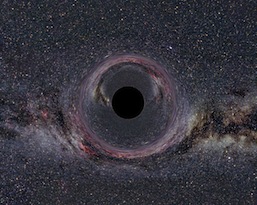
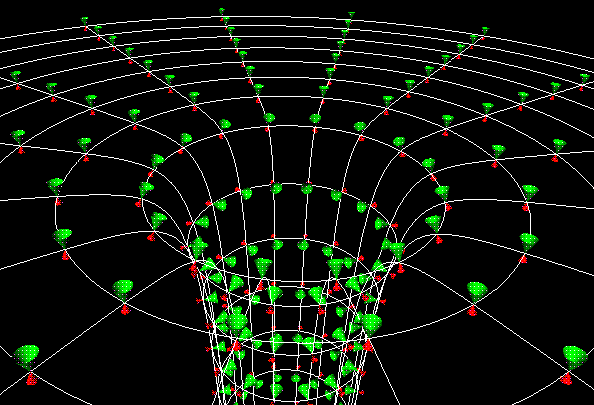
As the density increases, the path of light rays emitted from the star are bent and eventually wrapped irrevocably around the star, as shown in the header image. Any emitted photons are trapped into an orbit by the intense gravitational field; they will never leave it. Because no light escapes after the star reaches this infinite density, it is called a black hole.
The idea of an object with gravity strong enough to prevent light from escaping was proposed in 1783 by John Michell, an amateur British astronomer.
 In the year that Galileo died -- 1642, Sir Isaac Newton was born on Christmas Day. While not directly speculating on the existence of Black Holes, his work in Mathematics established the basis for which 18th, 19th and early 20th century astronomers would base their work. Can you imagine a work that stood for almost 300 years before being modified (by Einstein)? Newton struggled mightily to reconcile his development of higher mathematics -- he is credited with inventing Calculus, with his sense of Theology. In 1684, three members of the Royal Society, Sir Christopher Wren, Robert Hooke and Edmond Halley, argued as to whether the elliptical orbits of the planets could result from a gravitational force towards the sun proportional to the inverse square of the distance. Halley writes: "Mr. Hook said he had had it, but that he would conceal it for some time so that others, triing and failing might know how to value it, when he should make it publick".
 Halley went up to Cambridge, and put the problem to Newton, who said he had solved it four years earlier, but couldn’t find the proof among his papers. Three months later, he sent an improved version of the proof to Halley, and devoted himself full time to developing these ideas, culminating in the publication of the Principia in 1686. This was the book that really did change man’s view of the universe.
However, such "Newtonian black holes" are very different from black holes in general relativity.
They prevent only light from escaping (not, for example, a rocket ship) and only in certain Newtonian models of light (such as an emission theory).
So, black holes are really still just about proven, but by their nature, (being completely devoid of light), they cannot be directly imaged by our telescopes.
At present!!