COLOR CHEMISTRY
(More Technical Stuff)
 Color photographs requires use of special media capable of representing colors which are either produced chemically during the photographic processing phase or were directly painted onto Black and White pictures. It is contrasted with black-and-white photography, which uses media capable only of showing shades of gray, and does not include hand colored photographs. Some examples of color photography include prints, color negatives, transparencies and slides, and roll and sheet films.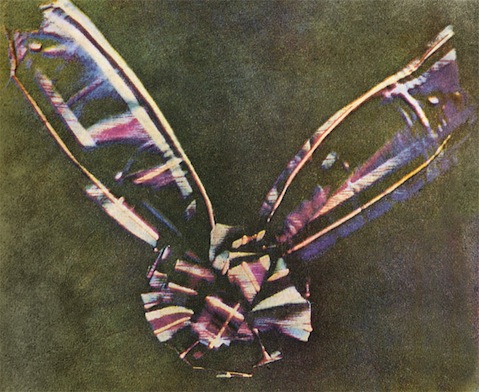
First color image, photograph by James Maxwell, 1861.
 Although color photography was explored throughout the 19th century, initial experiments in color resulted in projected temporary images, rather than permanent color images. Moreover until the 1870s the emulsions available were not sensitive to red or green light. In the color image to the left taken in 1877, by Louis Ducos du Hauron, a French pioneer of color photography, the overlapping yellow, cyan and red subtractive color elements can clearly be seen.
Practical methods to sensitize silver halide film to green and then orange light were discovered in 1873 and 1884 by Hermann W. Vogel (full sensitivity to red light was not achieved until the early years of the 20th century).
The first fully practical color plate, Autochrome, did not reach the market until 1907.
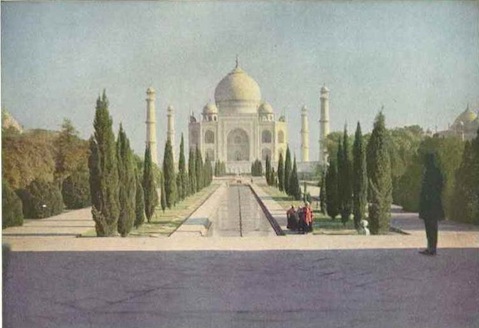
An Autochrome image of the Taj Mahal, circa 1921.
It was based on a screen-plate method, the screen (of filters) being made using dyed dots of potato starch. The screen lets filtered red, green or blue light through each grain to a photographic emulsion in contact with it.
The plate is then developed to a negative, and reversed to a positive, which when viewed through the screen restores colors approximating the original.

These required a special machine to display, but the results are impressive even by modern standards. His collection of glass plates was purchased from his heirs by the Library of Congress in 1948, and is now available in digital images.
ILFACHROME, (formerly known as CIBACHROME)
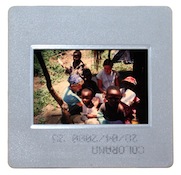 Cyberchrome is a dye destruction positive-to-positive photographic process used for the reproduction of slides on photographic paper. The prints are made on a dimensionally stable tri-acetate polyester base (got that?), essentially a plastic base opposed to traditional paper base. Since it uses azo dyes on a polyester base, the print will not fade, discolor, or deteriorate for a long time. Characteristics of Ilfochrome prints are image clarity, color purity, more environmentally safe, as well as being an archival process able to produce critical accuracy to the original slide.
The composition of the emulsion used in Ilfochrome/Cibachrome prints is responsible for color purity, image clarity, being environmentally friendly, and archival.
Unlike Type R processes by Kodak, Fuji, and others, Ilfochrome does not have dyes in the chemistry but rather in the emulsion.
Azo dyes, which provide stable vivid colors, are embedded in the Ilfochrome emulsion are bleached out in processing.

Although not completely environmentally safe, it is far more friendly than other processes because the toxic dyes begin in the emulsion and are removed rather than contained in disposable chemistry. As the colors formed from the azo dye are far more stable, the prints made from the process are archival and insisted on by galleries and art collectors as they will not fade in normal light.